
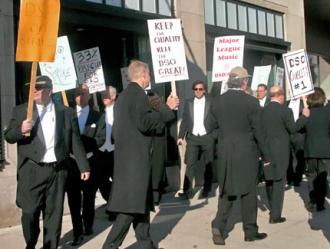
Detroit Symphony Orchestra musicians even wore their tailcoats on the picket line two years ago.

Detroit Symphony Orchestra musicians even wore their tailcoats on the picket line two years ago.

When they insist on white-tie-and-tails for men and black gowns for women, people who set dress codes for orchestras use arguments similar to those of educators who advocate for school uniforms.

Also, there’s a black-and-white uniformity to the look, which negates the individual and puts the focus on the corporate production of fine music.

In the 19th century, the (men) playing in the orchestra were dressed pretty much like the concert’s patrons. But what does the formality of this particular look say to a 21st century audience member in skinny jeans? Where else in daily, ordinary life do we see men dressed in tailcoats?

I liked the Toronto Symphony Orchestra’s casual-concert partnership with Banana Republic a few seasons ago, which saw the players dress in khakis. They played just as well, but the look of the sound came across as more friendly and approachable.

Music director Peter Oundjian gets it. He conducts in a Rosemarie Umetsu-designed black outfit that, aside from some more purely visual features, gives the maestro extra fabric in which to freely move his arms and shoulders.

Meanwhile, the violins and violas have to keep straining against their tailored tailcoats.

I wonder how much longer this is going to last. For example, New York City classical radio station WQXR reported yesterday on an ongoing experiment at the Baltimore Symphony, led by music director Marin Alsop, that is attempting to make a modern orchestra look modern as well.

You can read all about it here. And this is a video summarizing this intriguing collaboration with local fashion design students:

What do you think?

John Terauds

Tagged with:  
Share →

11 Responses to Why is it that orchestra musicians can’t dress to reflect their audience?

  1. I agree that formal dress on stage looks dated, but I love the visual cohesion that a common dress code provides an orchestra. Like the synchronized bowing of a string section, uniform dress provides a powerful visual reminder of the fact that so many individual artists are focussing their efforts towards a unified performance. I love what the BSO is doing, and I think modernizing the orchestral “uniform” could be a great way for orchestras to develop a sense of identity or organizational “brand.” I could see this being quite effective in shaping the concert experience for new audiences in particular: someone who has rarely or never heard an orchestra live might not notice the subtleties of sound that distinguish one major orchestra from another, but they will immediately notice if an orchestra has a particularly striking visual presence onstage.

    One logistical concern comes to mind: orchestras would probably have to establish a wardrobe department and an inventory of extra outfits in case subs or extra musicians are required. An advantage of the current dress code is that if someone in the orchestra gets sick, every player in the union directory has a black gown or a tux/set of tails in their closet.

  2. Regie, or Not Regie? says:

    I like the black shirt/black slacks (open collar) look that some European orchestras have adopted. As a singer and sometime orchestra player, I have always felt it unfair that the women get to wear a black outfit of choice (usually with open collar at least ) and we guys get stuck in our tuxes. But I suppose that’s really a different story.

    And Michael has a point about the fact that every male orchestra player and choral singer owns a tux, which makes it easy to step in as a ringer.

  3. Jamie says:

    Why not partner with local designers to create new looks for the TSO every season? Get involved with Toronto Fashion Week. Play a fashion show. Partner with a fashion design house for sponsorship. Our musicians deserve to look as good as they play. :)

  4. Bernie Vachon says:

    Marin Alsop also conducts the Cabrillo Festival Orchestra (http://www.cabrillomusic.org/) here in Santa Cruz, California. For as long as I can remember (I moved here in 1990) the musicians have worn casual clothing on stage. If I recall correctly, my cello teacher said that the orchestra members were expressly forbidden from wearing black and white. I think this is an interesting way to make modern orchestral music more approachable. During the weeks of the festival one can attend open rehearsals and get up close and personal with the musicians. Many of the musicians travel from far away to get here and they will lodge with local music lovers. Ms Alsop always programs interesting and challenging music. The concerts are very well attended. It doesn’t really surprise me that she would be involved in this visual re-design of the orchestra.

  5. Jane Smith says:

    One only needs to see Jonathan Crow in his tails to be aware that the tone of the evening has been raised even before the music starts!

    And how jarring is the lady with the blue hair???

    Uniformity allows the musicians to play alternate gigs, is cost effective for the players and imposes a level of good taste on those who may not have any!

    • What may be jarring to your generation is something that my generation understands and identifies with, and the idea that one’s choice of hair colour negatively impacts the experience of an orchestral performance is the sort of attitude that causes much of my generation to shun classical music. Today’s youth care far more for an artistic product that speaks to them than for artificial standards of how artists should look when performing. Nadina Mackie Jackson’s hair colour may not conform to our expectations of an orchestral musician, but it comes from a bold personal choice on her part, not a lack of good taste.

  6. Simon Capet says:

    Anything that brings the individual audience member closer to the individual players in an orchestra is a good thing and dress is one of the simplest and cheapest ways to distinguish between sections and individuals.

    An orchestra is a remarkable demonstration of how individuals can successfully come together to achieve a very complex common goal; the performance of music. Far too much emphasis is placed on uniformity. A symphony orchestra is not a machine, it is a glorious, company of diverse talent and personalities.

    A professional orchestral musician does not subjugate his or herself to the will of the conductor or the ‘sound’ of the orchestra. A great symphonic musician has the sensibility and self confidence to know when to project and when to blend or support. But make no mistake, even the most delicately balanced string section is still a vibrant tapestry of colours and textures. It’s not possible to have twelve violins of different make and age played by twelve different musicians sound like one violin. It is however perfectly normal for twelve empathetic violinists to find a perfect blend of their instruments and personal styles.

    My point is that when we go to see a symphony concert, and I do mean see a concert for our eyes play an important role in our experience, we are witnessing the combined talent and personality of eighty or more individuals. When I attend a performance I want to experience each and every one of the musicians connecting with the music, with their colleagues and with the audience.

    Having the orchestra all wear chinos, denim shirts and runners may appear to be more ‘hip’ and trendy but it is just as much of a uniform as the ridiculously antiquated white tie and tails. Not everyone looks their best in jeans and just as with the rest of society musicians come in every shape and size.

    When deciding on the dress code for an orchestra the goal must be highlighting the individuality of each musician whilst creating a visually satisfying picture for the audience. Orchestral musicians need to look good on stage both for their audience and themselves.

  7. RICHARD ILOMAKI says:

    Brava for Ms Alsop. Sitting in a full tux under stage lighting certainly does not improve a player’s musicality. Who knows, there may be an untapped source of revenue in letting designers drape the players as advertising, but heaven forbid they should be decked out like racing drivers with logos all over.

  8. Paul says:

    No-one who has sat under glaring stage lights stuffed into the many layers of a traditional tail/vest/shirt/bowtie trying to play a violin could ever feel that their performance is not being adversely affected . Hot, cumbersome, restrictive; nothing could be worse than the traditional outfit. Some years ago I made the decision to not accept any gigs requiring them. I’ve made a couple exceptions for some amazing concerts, but generally I’m happiest to work only where conditions allow me to do my best. And since string players need lots of room to move, their tails are usually oversized and look rather sloppy at the best of times. For me, the sooner they are gotten rid of, the better for the music and the musicians.

  9. Nic Gotham says:

    An orchestra performance is a performance – it has a necessary visual aspect. We don’t expect actors or dancers to dress just like us. A little formality is not a bad thing, but neither should the the orchestra’s dress look too old-fashioned. I like the idea of collaborations with designers because the players’ clothes have to function in a certain way – freedom of movement, etc.- as well as look good straight out of a suitcase! And I’m for more variation in the men’s stage attire – I mean besides the ties

  10. The Traveller says:

    Must everything in our degraded times be reduced to the level of homeless people huddling about a trash can fire? The sense of occasion formal attire brings to an event is important. If this troubles anyone it speaks more of their own self esteem. Have a little dignity and self worth. It goes a long way in life.

Leave a Reply

blank